Image




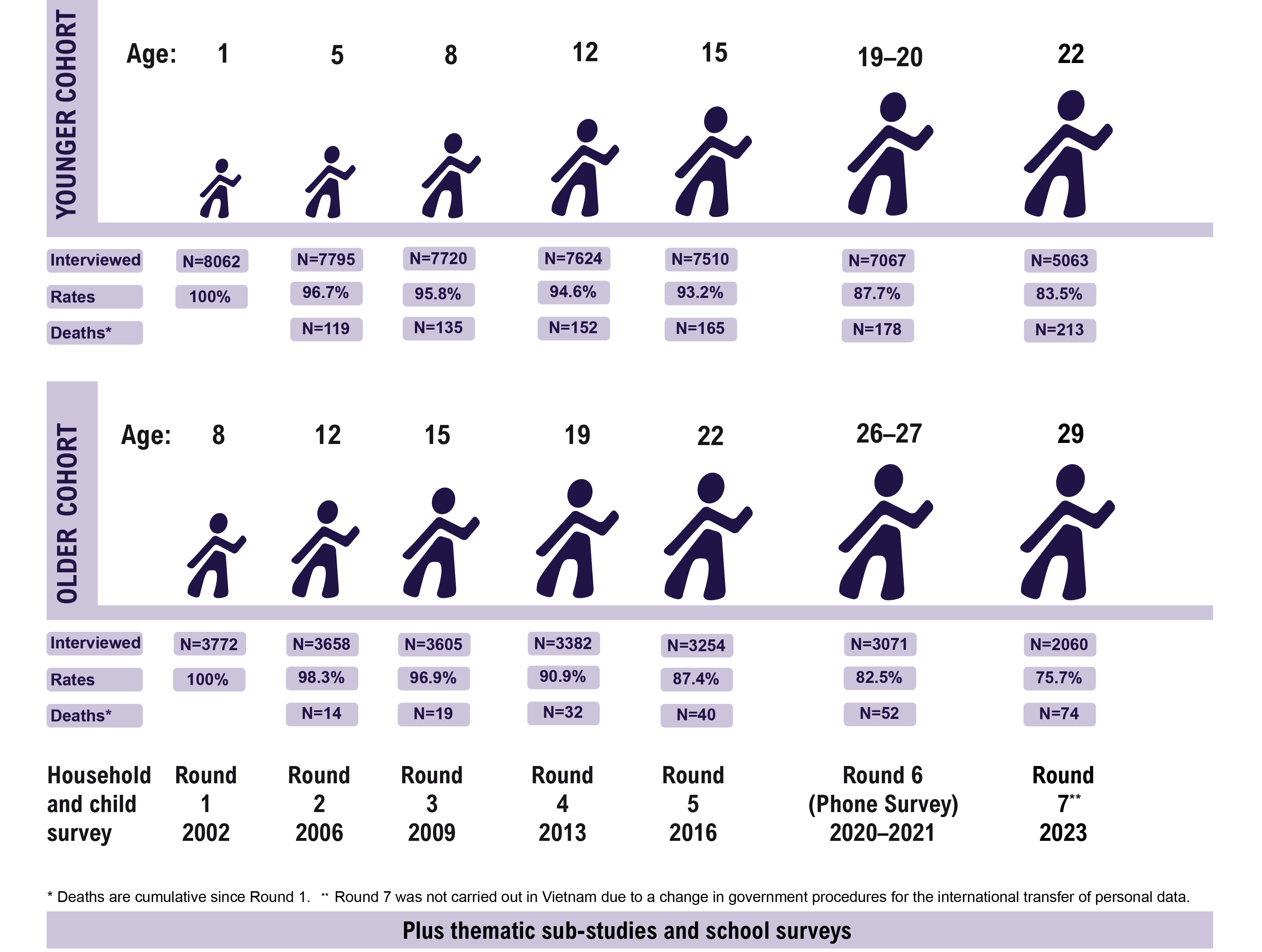
Round 7 fieldwork was conducted in Ethiopia, India and Peru between June 2023 and April 2024, when the Younger Cohort participants were approximately 22-years-old and the Older Cohort participants were 29-years-old. Data was not collected in Vietnam this round due to a change in governmental procedures for the international transfer of personal data.
Round 7 data collection was conducted in-person and included several components: a face-to-face interview, two self-administered sections: reading comprehension test and a self-administered questionnaire (SAQ); and biomarker measurements, which comprises of a cortisol sub-study and anthropometrics. Participants were required to provide additional informed consent for each component
In Round 7, Young Lives administered an individual face-to-face questionnaire to the participants that included questions about their education, work, time use, health, nutrition, well-being and family lives, among other aspects. Due to the participants' age, this questionnaire was a blended version of the household and child questionnaires from previous rounds. On this occasion, study participants were asked to answer household-related questions, unlike earlier rounds where their caregivers typically responded.
The questionnaires for the Younger Cohort and Older Cohort were primarily the same, reflecting that our participants are now in similar stages in life and data can be collected in the same way for both cohorts. There are a few exceptions for sections and questions collected for participants of the Younger Cohort only: migration expectations, pandemic education, reading comprehension, two components of the Review of Personal Effectiveness and Locus of Control instrument (ROPELOC), Grit scale, Attitudes Toward Women Scale for Adolescents (AWSA), and height.
Additionally, to account for the conflict in Ethiopia, we included some sections and questions in the Ethiopian version of the questionnaire only: perceptions of security, conflict experiences and a PTSD scale.
Young Lives does not release disaggregated location information of our participants. Round 7 datasets include the following geographical variables: Region level (Ethiopia), State (India) and Climatic Region (Peru). We also include a Cluster variable, which indicates if participants are still living in one of the original Round 1 clusters or they have moved to other areas. Finally, we include a variable for area of residence, indicating if they live in an urban or rural area.
Sensitive information – such as risky behaviours, sexual and reproductive health, and personal experiences with different types of violence – was collected through a self-administered questionnaire (SAQ) in Peru. In India and Ethiopia, audio-computer assisted self-interviews (ACASI) were employed for the first time, where participants privately listened to pre-recorded questions via headphones with gender-matched speakers and responded by touching coloured shapes on the tablet screen. These were administered in three languages in Ethiopia: Amharic, Tigrinya and Oromo and in Telugu in India. In Ethiopia, Young Lives also gathered highly sensitive data on the impact of the conflict.
Other self-administered components were: 1) the Reading comprehension test (Younger Cohort only) and 2) RACER (Rapid Assessment of Cognitive and Emotional Regulation), a tablet-based application featuring five brief visual cognitive tasks designed to assess foundational cognitive skills (Behrman et al. 2022). In Round 7, the first two tasks, which measure executive function, were re-administered to the Younger Cohort in Ethiopia and Peru. Data from RACER was collected as part of an internal sub-study and is not currently available to the public.
For the first time, Young Lives collected hair samples to examine cortisol levels in all three countries. This samples were collected as part of an internal Cortisol sub-study and its data is not currently available to the public.
This round also took anthropometric measurements: height, weight and abdominal circumference.
In Ethiopia, we also conducted a Phone Survey to reach our participants in two sites of Amhara region, who could not be interviewed in person because they were living in sites affected by armed conflict. The survey was a modified and shortened version of the original questionnaire to be administered over the phone.
This document provides detailed information to our fieldworkers and is used as a guide during the training sessions prior to the fieldwork. It includes guidelines on safeguarding, data management, protocols, ethical considerations, reciprocity and how to conduct the survey on the field.
The following documents correspond to additional documentation from the data collection process, attrition rates and technical notes on specific data collection procedures:
Our website also has some useful posts on the fieldwork and data collection process:
Round 7 fieldwork was conducted in Ethiopia, India and Peru between June 2023 and April 2024, when the Younger Cohort participants were approximately 22-years-old and the Older Cohort participants were 29-years-old. Data was not collected in Vietnam this round due to a change in governmental procedures for the international transfer of personal data.
Round 7 data collection was conducted in-person and included several components: a face-to-face interview, two self-administered sections: reading comprehension test and a self-administered questionnaire (SAQ); and biomarker measurements, which comprises of a cortisol sub-study and anthropometrics. Participants were required to provide additional informed consent for each component
In Round 7, Young Lives administered an individual face-to-face questionnaire to the participants that included questions about their education, work, time use, health, nutrition, well-being and family lives, among other aspects. Due to the participants' age, this questionnaire was a blended version of the household and child questionnaires from previous rounds. On this occasion, study participants were asked to answer household-related questions, unlike earlier rounds where their caregivers typically responded.
The questionnaires for the Younger Cohort and Older Cohort were primarily the same, reflecting that our participants are now in similar stages in life and data can be collected in the same way for both cohorts. There are a few exceptions for sections and questions collected for participants of the Younger Cohort only: migration expectations, pandemic education, reading comprehension, two components of the Review of Personal Effectiveness and Locus of Control instrument (ROPELOC), Grit scale, Attitudes Toward Women Scale for Adolescents (AWSA), and height.
Additionally, to account for the conflict in Ethiopia, we included some sections and questions in the Ethiopian version of the questionnaire only: perceptions of security, conflict experiences and a PTSD scale.
Young Lives does not release disaggregated location information of our participants. Round 7 datasets include the following geographical variables: Region level (Ethiopia), State (India) and Climatic Region (Peru). We also include a Cluster variable, which indicates if participants are still living in one of the original Round 1 clusters or they have moved to other areas. Finally, we include a variable for area of residence, indicating if they live in an urban or rural area.
Sensitive information – such as risky behaviours, sexual and reproductive health, and personal experiences with different types of violence – was collected through a self-administered questionnaire (SAQ) in Peru. In India and Ethiopia, audio-computer assisted self-interviews (ACASI) were employed for the first time, where participants privately listened to pre-recorded questions via headphones with gender-matched speakers and responded by touching coloured shapes on the tablet screen. These were administered in three languages in Ethiopia: Amharic, Tigrinya and Oromo and in Telugu in India. In Ethiopia, Young Lives also gathered highly sensitive data on the impact of the conflict.
Other self-administered components were: 1) the Reading comprehension test (Younger Cohort only) and 2) RACER (Rapid Assessment of Cognitive and Emotional Regulation), a tablet-based application featuring five brief visual cognitive tasks designed to assess foundational cognitive skills (Behrman et al. 2022). In Round 7, the first two tasks, which measure executive function, were re-administered to the Younger Cohort in Ethiopia and Peru. Data from RACER was collected as part of an internal sub-study and is not currently available to the public.
For the first time, Young Lives collected hair samples to examine cortisol levels in all three countries. This samples were collected as part of an internal Cortisol sub-study and its data is not currently available to the public.
This round also took anthropometric measurements: height, weight and abdominal circumference.
In Ethiopia, we also conducted a Phone Survey to reach our participants in two sites of Amhara region, who could not be interviewed in person because they were living in sites affected by armed conflict. The survey was a modified and shortened version of the original questionnaire to be administered over the phone.
This document provides detailed information to our fieldworkers and is used as a guide during the training sessions prior to the fieldwork. It includes guidelines on safeguarding, data management, protocols, ethical considerations, reciprocity and how to conduct the survey on the field.
The following documents correspond to additional documentation from the data collection process, attrition rates and technical notes on specific data collection procedures:
Our website also has some useful posts on the fieldwork and data collection process: